The FRQGAN4AD Project
The FRQGAN4AD Project combines quantum mechanics and generative AI to develop a Quantum Generative Adversarial Network (QGAN) for network anomaly detection. By addressing the challenges of quantum noise and the need for distributed computation, the project innovates through federated QGANs secured with blockchain.
Key Highlights
- Utilizes QGANs to generate high-quality data for detecting network anomalies.
- Implements a federated approach to train models locally and aggregate results securely.
- Integrates blockchain to ensure traceability in federated learning.
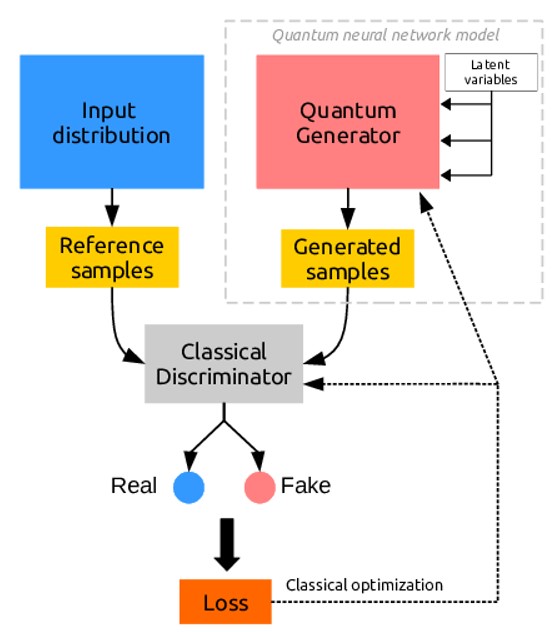
Quantum GAN training process.
Innovation
The project pioneers the use of QGANs in anomaly detection for next-generation networks (NGIs). It also introduces a federated model compliant with EU AI regulations, integrating human-in-the-loop (HITL) strategies for enhanced compliance and transparency.
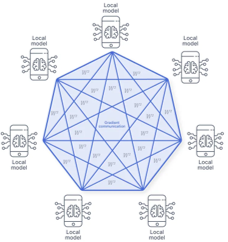
Federated QGAN approach.
The project’s outcomes, including software and datasets, will be open-sourced on GitHub to promote collaboration within academic and industrial communities.
Education Materials
To support dissemination and training, each article produced in the FRQGAN4AD project is complemented with dedicated presentations. These resources are made openly available for researchers, students, and practitioners.
-
A QPUF-Based Scheme for Secure and Adaptable Quantum Device Attestation in NISQ Devices – International Conference on Quantum Communications, Networking, and Computing (QCNC 2025) March 31-April 2, 2025 · Nara, Japan
Presentation |
Article
-
Intrusion detection using quantum generative adversarial networks: a federated approach with noisy simulators – IET Space and Communications Conference 2025
Presentation |
Article
-
Federated Quantum Generative Adversarial Network for Intrusion Detection – IEEE ICDCS 2025 (45th IEEE International Conference on Distributed Computing Systems)
Poster |
Article
-
Quantum Machine Learning for Intrusion Detection on Noisy Quantum Computers – IEEE International Conference on Quantum Computing and Engineering 2025
Presentation |
Article